
Sigma Zoom-Pi 35-200 4-5.6
Published
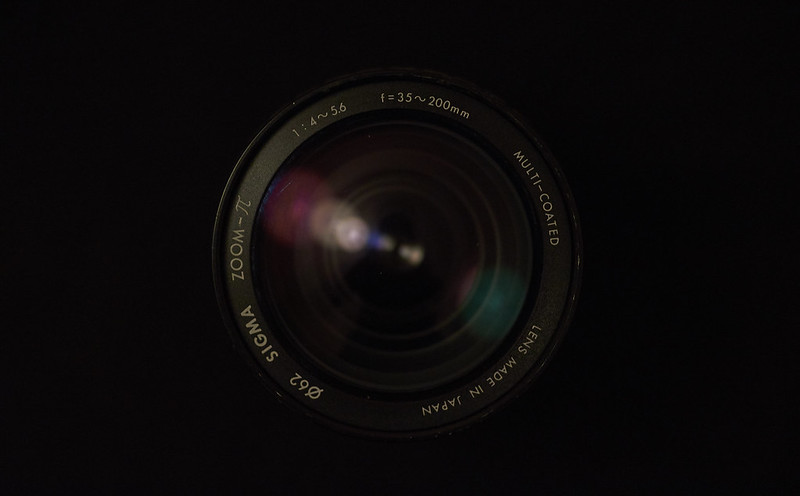
- Mount
- M42
- Focal length
- 35–200 mm
- Max aperture
- 4
- Minimum focus
- 0.45 m
- Filter size
- 62 mm
- Weight
- I didn't weigh it
- Coating
- MULTI-COATED
- Type
- Zoom
Lens story
This review was originally written nearly two and a half years ago, so I've tweaked it heavily. Back then I wasn't sure what format to follow, what to do or not do. I tried taking ten pictures at each aperture, but later realised that, personally, when I look at reviews, I don't care about charts. I want to see how lenses are used in real life. If I want to zoom in on the corner, I can do that myself. One of my visits to Germany took me to a local flea market, where I picked up a pristine Olympus OM-10, which came with two lenses: a 50mm 1.8 and the Sigma. This was my first OM camera.
Handling
A lens with such a wide zoom range was designed so you don't have to carry a lot of lenses. You saved space, weight, and back pain. That was before plastic was a common material in lenses. After using modern zoom lenses, you're used to a light package that doesn't weigh you down. The Sigma Zoom-Pi feels a bit like a big, heavy beast, which rules it out as a walk-around lens, at least for me. It's not well balanced on the Sony A7. I constantly found myself worrying about my lens mount getting damaged. The upside is that the metal construction makes this lens feel solid, and a good choice of self-defense equipment.
The lens features a "one touch" push-and-pull zoom, where you use one ring to both zoom and focus. It feels smooth and isn't that bad in use, although you sometimes accidentally zoom in or out.
Optical performance
Wide open, this lens is not that sharp, even with its slow aperture. Chromatic aberrations are well controlled, and flaring isn't a big issue. There's a lot of spherical aberration, adding to the feeling you get when you shoot from a plane or a mountain top. Stopping down doesn't improve things as much as I'd like. Images still feel as though you're shooting wide open. Sharpness and contrast don't improve that fast. By f8–f11 you can still get decent image quality, but there are a lot of better options that become usable by f5.6.
I can hear a chorus of forum members screaming "WHAT WOULD YOU EXPECT OF A VINTAGE ZOOM LENS". You know how forums get.
Zoom the lens out to 200mm and you can focus down to 1:3.7 magnification.
I'm guilty of undervaluing magnification on macro lenses, to a point where I've found myself unhappy if I read that a lens goes to 1:2 and not 1:1. It's silly to judge by numbers on paper instead of actual images first, isn't it?
Well, this lens proved me wrong. In macro mode you can get some decent results, and the 200mm focal length means you can keep a good distance from your subject. The Sigma Zoom-Pi performed much better in macro mode than at 35mm.
Wide open or stopped down, this lens always seems to suffer from poor contrast and desaturation. Color improves when stopped down, but it's nothing to write home about. Although it gives images a specific look, it might not be everyone's cup of tea.
Distortion is tricky with vintage zoom lenses. At the low end of 35mm you get barrel distortion, while zooming in to 200mm it hands the field over to pincushion.
Final thoughts
I didn't really enjoy using this lens much. Although having the 35–200mm range was nice, I found myself mostly using the long end, at 200mm. The macro function is nice to have, and really the best thing about this lens, in my opinion. The size and weight alone are a deal-breaker for me. I'd rather go with a few primes that are smaller than this big metal beast. (Or I'd grab my Zenit 12 and carry that around. Or, you know, a bag of rocks.)