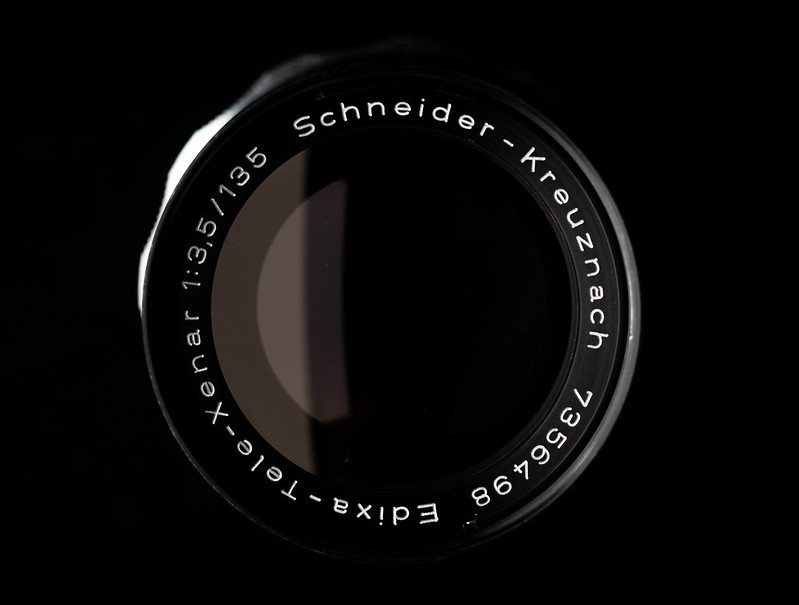
Schneider-Kreuznach Edixa-Tele-Xenar 135mm 3.5
Published
- Mount
- M42
- Focal length
- 135 mm
- Max aperture
- 3.5
- Minimum focus
- 2 m
- Filter size
- 49 mm
- Weight
- 305 g
- Coating
- Single coated (as far as I can tell)
- Type
- Prime
Lens story
This one got to me in an interesting way. A very close friend of mine studied at a university abroad. When the year is over, students need to move out and sometimes clear out or leave their stuff. A friend of his, who knew he was into photography, approached him with a leather camera case they didn't need. It had 2 lenses and a Praktica. He accepted the gift. Fast-forward a couple of years and the lenses and camera end up with another friend, who was trying out manual-focus vintage lenses. In the end he settled on landscape photography and modern lenses. Fast-forward a few more years and I'm visiting the town where both of them live now. I notice the lenses and start inspecting them. My friend, noticing this, offers to give them to me, since he doesn't use them anymore. The Schneider-Kreuznach Edixa-Tele-Xenar 135mm 3.5 has a very interesting and intricate design, so I couldn't refuse.
Handling
First things first, I'll just call this lens the Schneider, since Schneider-Kreuznach Edixa-Tele-Xenar 135mm 3.5 is kind of a mouthful. If I ever took into consideration how a lens looks, this one is it! It's a simply beautiful lens. I have the first zebra version with the wider rings, and it's striking how well made and designed the whole lens is. The focus and aperture rings on the Schneider are well positioned and easy to grip. For a 135mm, this lens isn't that long and, albeit on the heavy side, is a pretty compact little gem.
The A/M switch isn't like anything I've seen before, more reminiscent of the endless knobs and levers on a leaf shutter than of a TLR.
What impresses me the most is the ingenious depth-of-field scale. While you turn the aperture ring, a little orange line expands and retracts in a transparent window. This gives you a nice visualisation of how each f-stop affects your depth of field. It's not something I used a ton, but it's a marvel to look at, and I do appreciate the design.
One note is that the original lens hood is a metal piece that makes putting on a lens cap a bother, although it looks good, in the same style as the lens.
Optical performance
This lens is a mixed bag. I'm having a really hard time deciding what to make of it. Sharpness-wise, I think it's good. The centre is sharp, and the corners catch up nicely by f8. (I mean, how many lenses don't, right?) Contrast is mediocre. I caught myself bumping it up a bit more than I usually do.
Flare wasn't an issue, since I always used it with the original lens hood, although I suspect the single-coated elements won't handle themselves that well without it. Vignetting is very noticeable wide open, and you have to stop down all the way to f5.6 to see a good improvement. Chromatic aberrations are rampant. They're spread out and cover all the edges in sunlit scenes. If you don't zoom in on your photos, you might shrug this one off.
Here's where I'm most conflicted about the Schneider: the colors. They're plain, bland, and flat. It's not hazy wide open, but it feels like the images are devoid of life in the RAW files. This could have its benefits if you're aiming for some subtle black-and-white shots, but it's not my cup of tea. Almost all of the images from the Schneider had the colors corrected to match what I liked.
Final thoughts
It's a beautiful lens. It's sleek and solid, while still a small package. It's a mixed bag of optical pros and cons, and while it was a nice ride, I doubt I'd reach for it when picking a lens to shoot with.