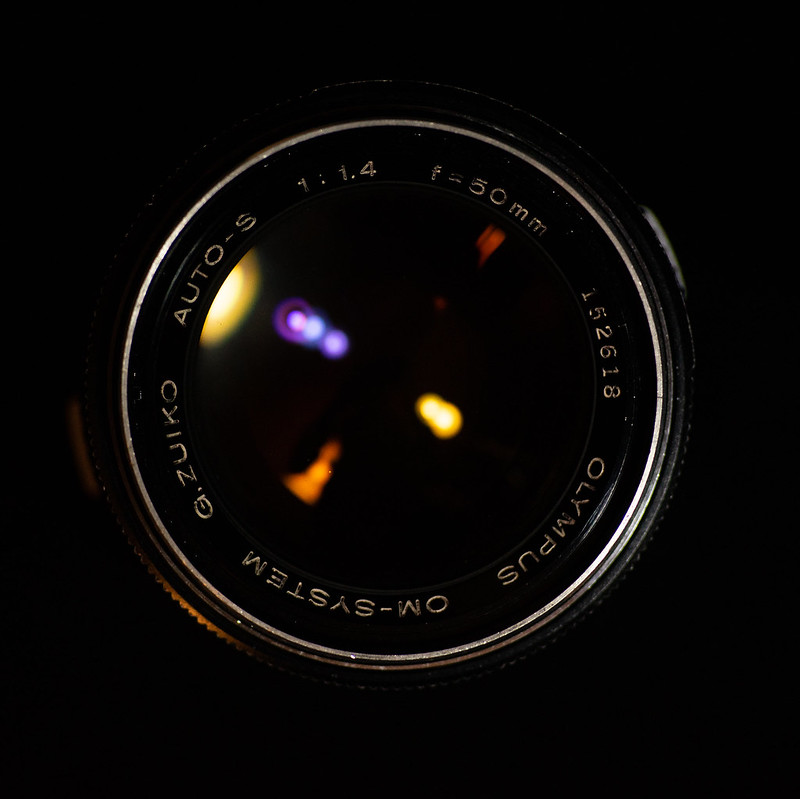
Olympus OM 50mm 1.4
Published
- Mount
- Olympus OM
- Focal length
- 50 mm
- Max aperture
- 1.4
- Minimum focus
- 0.45 m
- Filter size
- 49 mm
- Weight
- 230 g
- Coating
- Yes
- Type
- Prime
Lens story
I've recently had a fascination with Olympus OM lenses, mainly because I have an Olympus Pen FT and an adapter which allows use of such lenses. I've been seeking a few out, but had little success, as they seem rare where I'm at. I had that itch I feel about twice a year: a good, fast 50mm. I wanted to try the Olympus OM 50mm 1.4, but one thing always stopped me: thoriated glass. You'll read forums and posts and articles, and watch videos, with opinions ranging from "If you're worried, send them to me *haha*" to "This thing gives out so much radiation it's scary!!!" This has led me to pass up a beat-up Olympus OM 55mm 1.2 lens that was as yellow as autumn. (Lenses with optics containing thorium tend to turn yellow with time.)
The first time I learned about radiation in lenses, I decided I'd steer clear of lenses like that. After all, even if the effects are minimal, why risk it? I might've gotten a bit obsessed and gotten an old Russian Geiger meter from a second-hand stuff website.
Background radiation measured somewhere between 0.20 and 0.30, in whatever unit it measured. Silly me, getting something I didn't fully understand. I did check all of my lenses, and none changed that reading too much, though.
Fast-forward to a work trip to London. I had a blast, got some good work done, and couldn't pass up the opportunity to browse all of the shops within a few-kilometre radius on my lunch breaks. A bit disappointing, but I didn't find anything I found interesting. (I did, but at prices I wasn't prepared for.)
That is, until, in one store, I saw the Olympus OM 50mm 1.4 lens. I asked to take a look at it, hoping it was a newer one, hence no thorium. Well, it wasn't. You could clearly see a golden-brown tint in the glass. I was about to let it go when I noticed the aperture was slick with oil. Asking the store owner, we agreed to cut the price by half. They insisted it wasn't usable. I knew my Sony to Olympus OM and Olympus Pen F to OM adapters didn't care about oiled apertures.
I ended up getting the lens. As soon as I got home, I decided to give that clunky Geiger meter a test. On the front element it showed 4.00, compared with 0.30 background radiation. I used it for a few walks and ended up selling it, after my curiosity was sated. (To a gent who knew what it was, and who has several such lenses, including some glowy Takumars.)
Handling
My glowy copy had a slightly stiff aperture ring and a well-oiled aperture, not enough to bother me, though. It handles pretty well and is amazingly compact for a 1.4 lens. I quite enjoy the placement of the aperture ring on OM lenses. Having it at the front ensures I don't mistake it for the focus or zoom ring, like I've done exactly 3 times in the past. (Or a lot more. I don't remember.)
Optical performance
Let's face it: if you get an f1.4 lens, you're not really that excited to shoot it at f4. You're dreaming of that creamy bokeh, that versatility of shooting in low light, and that bittersweet radiation dose. (Do I hear the wind outside my window whisper "Takumar"?) Wide open, the lens is not the sharpest tool in the shed. Surprising, right? You get a lot of vignetting, reduced contrast, spherical and chromatic aberrations, the whole ordeal.
The Olympus OM 50mm 1.4's bokeh is something that surprised me. I expected it to be a lot smoother, while instead it was somewhat harsh for my taste.
Colors were muted and washed out, but not in a smooth way. It was as though they lacked vibrancy. No matter the color temperature I'd dial in on Lightroom, 7 out of 10 times (not a made-up number, right?) I'd find the results lacking.
But oh! The salt to the pepper of f1.4 lenses: portraits! The harsh bokeh and all the imperfections really made for an interesting look, trippy, as if fluid and coming right at you, with a certain sense of liveliness and motion. When stopped down to f5.6, the lens sharpens up nicely, now almost usable for landscape work, although with chromatic aberrations still running wild. This shouldn't really be a problem unless you don't correct for that. Like I don't.
Shooting out in daylight brought a lot of flare and ghosting, mostly in bizarre forms spanning the whole image. (Perhaps irradiated ghosts of the past?)
Final thoughts
This lens is great as a niche lens for portraits, or as a lens if you need that specific down-low, bleak look, which I'm sure some videographers would kill for. If you want to get funky portraits, reminiscent of optical illusions coming at you, find some branches and shoot away for that busy bokeh, which seemed almost too easy to achieve.
I had the lens for 3 weeks and I didn't join the Avengers, but hey, it was my first thoriated lens.