
Leitz Elmar 5cm 3.5
Published
- Mount
- LTM
- Focal length
- 50 mm
- Max aperture
- 3.5
- Minimum focus
- 1 m
- Filter size
- 19 mm (inner?) 36 mm push-on (?) Do double check this.
- Weight
- 210 g~
- Type
- Prime
Lens story
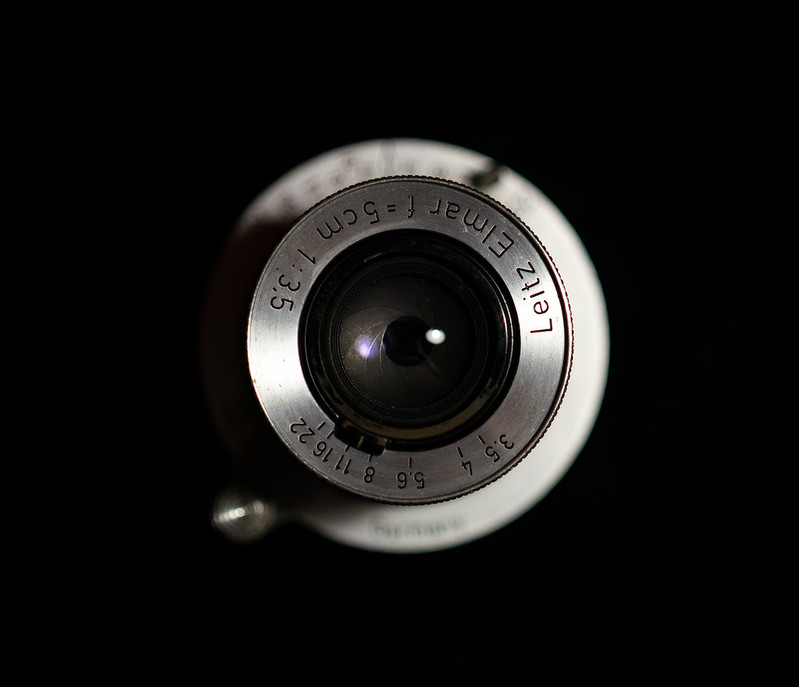
The collapsible Elmar 5cm 3.5 lens is one of the first lenses I wanted to have for my film Leica IIf. The idea of having the camera in an oversized coat pocket really appealed to me. My copy came with a slip-on hood and a filter, which was great. Fun fact - I own the version that has red lettering, which wasn't initially obvious. Old age and dirt had made the engraving appear black, but a quick clean showed the red below.
Handling
This lens is one of the classics, along with the ones I always confuse: Summilux, Summicron, Summisomething. It makes your screw-mount Leica very slim and feels right at home on the camera. There's a lot I like about the lens, but most of the handling comes down to working around the lens design itself. The lens can retract safely into a film camera body (although it looked harmless, and possible, on the Sony a7, I kept it extended just in case), which makes your camera very small. That does mean you have the extra step of extending the lens each time you want to take a photo. Another small thing to consider is that you need to check you've "locked in" the lens barrel after extending it. The aperture ring is a small piece near the front element, which might be difficult to use if you have big fingers. If you mount the lens hood, it gets even harder to change. If you mount a lens filter, you'll need to take it off to set the aperture (I personally used a bigger filter that fit the hood). In the end it was easier to remove the whole hood (with the filter still on it) when making changes. This makes for a lengthy process each time you take the camera from your coat pocket. The 1-metre focusing distance is nothing to write home about, but it does limit you a bit if you're used to more modern 50s. The focus knob is something you get used to fairly quickly, and the hard stop at infinity helps a lot. Keep in mind, if you want to use this with an adapter or on a FED/Zorki, the focus knob might extend too far into the camera, making infinity impossible to set. (Good thing it's an already slow lens, so it didn't affect performance too much.)
Optical performance
I like this lens, both on digital and on film. But because of the handling quirks described above, I'll stick to using it on film. It produces lovely colors, has good contrast in the center, and some vignetting. It's a good portrait lens, if you can live with less bokeh. Lens flare was an issue, although greatly improved by a lens hood. Still, having a light source in the frame caused some ghosting and artefacts. Stopping down the lens improves performance a lot and gives you nice sharpness across the frame. Overall, I'm very happy with the lens, especially when using it for black-and-white work.
Final thoughts
This is a good example of a lens that has a lot of unique aspects to it, some inconvenient and others not so much, that can still be a pleasure to use. It's a Leitz (Leica) lens, so a good copy would cost a bit, but it might just be worth it. One thing to note is that as time passes, finding a good copy might be harder, with a lot of them having the coating either stripped from cleaning or heavily damaged. The coating on mine isn't ideal either, but I can live with that.