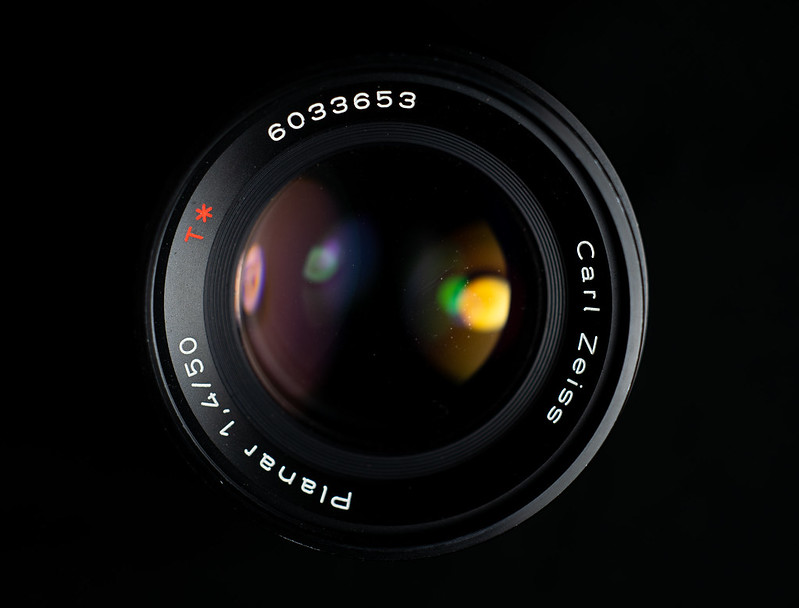
Carl Zeiss Planar 50mm 1.4 T
Published
- Mount
- Contax / Yashica
- Focal length
- 50 mm
- Max aperture
- 1.4
- Minimum focus
- 0.45 m
- Filter size
- 55 mm
- Weight
- 290 g
- Coating
- T
- Type
- Prime
Lens story
I generally don't borrow lenses. I prefer to own a lens, then if I'm not using it, sell it and buy another. Owning a lens means if something happens (please no) and the lens takes a ding, is dropped, gets wet, or whatever, you pay for it. Borrowing makes it a tad more tricky. I'm always careful with my gear, but the thing is, old lenses are unpredictable at times. I've had 3 lenses break down unexpectedly (mostly the aperture getting stuck, or a blade out of place). Although I generally avoid it, at times I'm so curious about a specific lens that I'd ask a friend to use it for a few months. The Planar optical formula dates back to 1896, when Paul Rudolph formulated it for Carl Zeiss. A ton of lenses through time have used the formula, but I had never actually shot one that carried the name Planar, and it was time to try it.
Handling
The lens handles like a charm. It has a solid metal feel to it, and both aperture and focus are a dream. Just holding it, you can tell this is a well-made lens and it's going to be easy to use. The Contax/Yashica mount isn't the most used one out there, but finding an adapter is fairly easy. Lenses in the mount can be adapted to both mirrorless cameras and to the Canon EOS lens mount, which might drive demand. I shot the lens on the Sony a7 and was happy with the combo. On the film side I opted for a Yashica FX-3 2000 for the high shutter speed (the top is 1/2000), and the plastic body weighed less than the lens! I always find the 55mm filter size a tad annoying, as I'm used to 49mm, but some of my more modern lenses luckily used the same size.
Optical performance
It's a 1.4 lens. Of course I'll shoot it and try it out at f1.4. I honestly expected results that would blow me out of this world, but that's on me for overhyping a lens before trying it. That's not to say that this isn't a superb lens. Wide open you'll notice some heavy vignetting, but center sharpness is good (not a given with fast 50mm lenses). Although subjective, the bokeh was to my liking. It does exhibit some of that "Zeiss" pop (or microcontrast) that folks rave about. Stop down to f4–f8 and contrast, detail, and vignetting improve a lot, as expected of a premium 50mm lens. I've had no trouble with chromatic aberration and lens flare. The T coating does a fine job.
What made shooting this lens a bit underwhelming was the colors. They were on the neutral side and didn't really stand out that much from other similar lenses I've used (e.g. the Pentax 50mm 1.4). That's not a bad thing if you're looking for a good lens that works well. Just don't expect overly saturated or vivid colors. This lens really shines at portraits, and that's what my favourite use was so far. Although detail in the centre wide open is good, it's well suited for portrait work. It complemented films like Portra 160 really well, and was perhaps the closest I've gotten to the look I want on this particular film stock.
Final thoughts
This lens falls into a tricky category. Each major player has had a 50mm 1.4 lens. When film was the main format, that extra stop of light was invaluable. It's a bit pricey, but it has the build quality and optical performance to match. Overall, if you're looking for something different, this might not be the lens for you. If you're looking for a lens that won't let you down, go for it. It's solid.