
Minolta MD W. Rokkor 28mm 2.8
Published
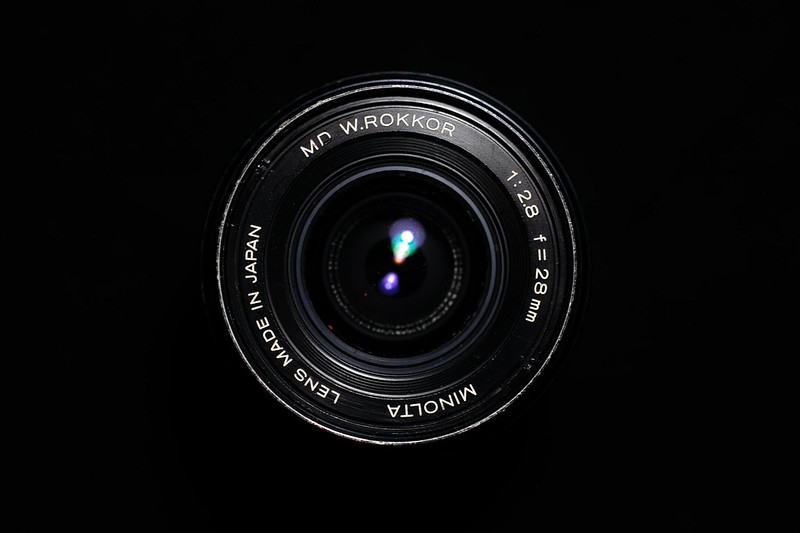
- Mount
- Minolta MD
- Focal length
- 28 mm
- Max aperture
- 2.8
- Minimum focus
- 0.3 m
- Filter size
- 55 mm
- Weight
- 200 grams~
- Coating
- Yes
- Type
- Prime
Lens story
I hadn't visited a flea market in almost a year. I didn't keep my hopes up about finding a camera or lens. I was just happy to go for a walk with a friend, chat a bit, and have a look around. I had my walk, and I was now ready to head home, when at one of the vendors I noticed a lens. I picked up the Minolta MD W.Rokkor 28mm 2.8 in none of its glory. Outdoor flea markets are sometimes sad places. Old cameras and lenses, left in the summer heat and autumn rain, and neglected.
I picked up the lens and showed it to my friend, stifling a smile. The seller immediately saw me pick it up, approached, and said it was mine for 10 currency. There was obviously water damage at play. Dried-up white residue, green in several spots, all over the lens barrel (limestone? corrosion? rust?). The focus ring was stuck, or so stiff it felt like it. There was fungus and spots all over the optics. The only working part seemed to be the aperture.
I decided that, for the price, I might as well try my hand at repair and see what I could do with it.
Handling
After cleaning the lens barrel, disassembling it, and rubbing the lens down, the focus of the W.Rokkor 28mm is now smooth. Handling is good, as expected of an MD lens. Judging from research, this copy is the first generation, the all-metal type.
It has a 55mm filter thread, which is not a personal favourite, but it is what it is.
The lens has half-stops on the aperture scale between f4 and f16, which is a nice touch.
Optical performance
In the Handling section I mentioned the good news: mechanically, the lens is now good. Optically, things didn't go as smoothly. Fine fungus has etched the rear element, and the front element has both fine and larger (although not the worst I've seen) scratches. On the plus side, I've learned what "Schneideritis" is! It's slang for little bubbles that form in the paint coating the sides of the lens elements. It looks like a lot of small dots!
This goes to show, and then some, how much of a beating a lens can take before becoming unusable. I don't pixel-peep or shoot test charts, so even with all of the above I still found the lens lovely.
Contrast was within a reasonable amount, and chromatic aberration was well controlled. Distortion, albeit a weird mix, is negligible for my use. Sharpness surprised me, pleasantly, for how the glass looked!
Now for the bad part. You didn't think this lens was just a magical zombie brought back from the brink, did you?
Vignetting and light falloff are very heavy when wide open. By f4 it gets more manageable, but overall this is not a strong side of the lens, unless it's shot only stopped down.
Flare! Shooting during the day, even with a lens hood, was a recipe for flare, with several images getting scrapped because of that.
Final thoughts
If any of my rambling opinions on lenses deserved a grain of salt, it was this one. I really enjoyed shooting the Minolta MD W.Rokkor 28mm, and I'll most likely stick it on my Minolta XD-11 for a try. The focal length, colors, and sharpness were all to my taste, which just makes me wonder: what could this lens do if it had not been left in a waterlogged drawer, in a damp place, for years? How much were the positives lessened, and how much were the negatives increased?
It might be a good idea to browse some photos online and read a few more reviews before deciding for yourself.