
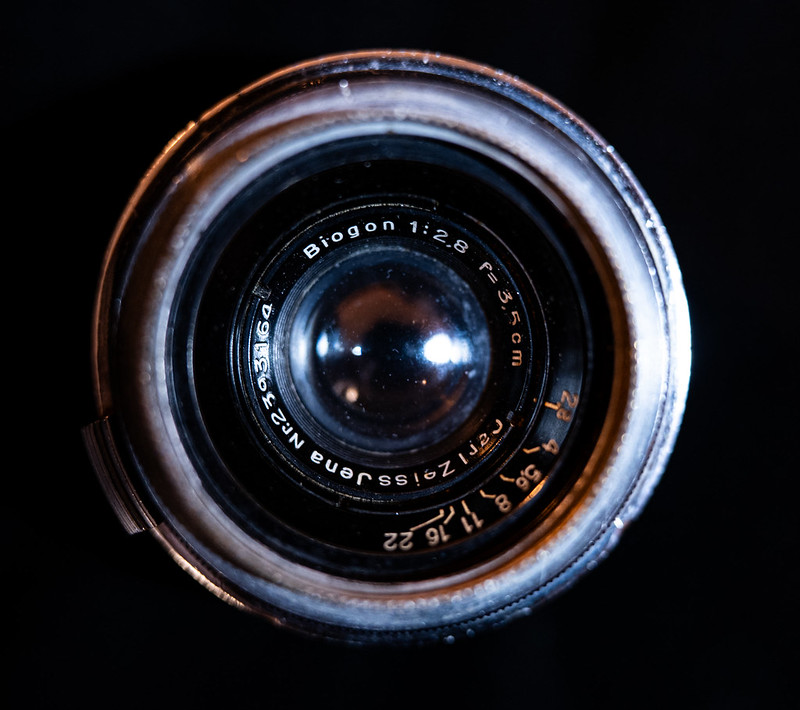
Carl Zeiss Jena Biogon 3.5cm 2.8
Published
- Mount
- Contax rangefinder
- Focal length
- 35 mm
- Max aperture
- 2.8
- Minimum focus
- 0.9m
- Filter size
- 40.5
- Weight
- 235gr
- Coating
- No
- Type
- Prime
- Year
- 1938
Lens story
The 3.5cm Biogon is one of those lucky online finds, where you see a lens lot and identify something you'd like. (After checking everything in the photos meticulously.)
I'm always a bit hesitant about getting more Contax rangefinder lenses, partly due to how they adapt to digital and my slight dislike for using them on a Kiev camera (if they even fit properly). This is offset by my love for Zeiss and curiosity about lenses this old. I've unintentionally assembled a small pre-war uncoated collection of Contax lenses, with the Biogon joining two Sonnars, and these are some of my favourite lenses to date!
It's a really old lens, most likely made around 1938 judging by the serial number. (Fun fact: the lens barrel has a second serial number, which matches the last 6 digits of the front one. So it has the front and back together, like they came out of the factory.) It is uncoated and it lacks the red T on the front ring, while the rest of the lettering has faded in some places.
Handling
Could you imagine that in 13 years (date of review: 2025) this lens will be 100 years old?
The Contax rangefinder mount is a bit tricky to adapt. You either get a very expensive adapter or try to create one from a defunct Kiev camera and then try to adjust it for infinity (if needed). I've gone the route of making one, using a Kiev mount and an M39 to Nikon Z adapter.
The filter thread is 40.5mm, which makes attaching a hood or filter a bit tricky. I've opted for a 40.5 to 46mm step-up ring and then a 46mm to 49mm one on top of it. This acts like a smallish hood and lets me use the plethora of lens caps and filters I own.
The focus ring is surprisingly smooth for such an old lens, which hasn't been CLA'd as far as I can tell. (Or it was done by a professional who left no trace.)
Changing apertures is done by rotating the front part of the lens barrel, but it is not annoying to do. (Unlike some screw-mount Leicas.)
The minimum focus distance is 0.9m, which isn't ideal, but is expected for the Contax.
One last thing to mention here is that the rear lens group protrudes a lot, which might be a consideration when using it on a digital camera, or any early non-Contax camera. (Still, only certain Contaxes (pre-war) would accommodate it.) I own a Contax RF to M39 adapter and it would not fit on a Leica IIf. Please do your research before adapting this lens, lest you brick it or fuse it to a camera.
Optical performance
Contrast is on the lower side, as expected, but sharpness (especially in the center) is good.
I expected a lot less and got more than I dreamed of with this lens, with one caveat: flare. Uncoated lenses tend to flare a lot, and this was evident when using the lens during the day (especially midday). In my books this eliminates it as a good walk-around lens. When it flares, there's a lot of ghosting and loss of contrast. It feels like the skies (or highlight areas in your frame) are glowing!
Each lens comes with strengths and weaknesses. While flaring was an issue during the day, I found the lens's performance really close to what I want indoors and at night. Subtle and gentle colors, with a slight softness. Contrast that isn't tack-sharp, unnatural, or in your face.
Shooting the Biogon 3.5cm 2.8, especially at night, helped me produce images that were really close to the atmosphere I adore seeing in photographs: calm, serene, and peaceful.
Final thoughts
While I enjoyed shooting this lens a lot, due to its age and lens mount I'm hesitant to recommend it.
It falls nearer to a collector's item and is far from a lens you'd typically search around for. If you do find one (at the right price as well), it's a very fun lens! If you do find a rare one in the M39 mount, even better!